I have included this little bit of fun as an example of what you could try and sometimes fail to do with a Sirius/Victor computer all in the name of 'improving' performance.
The NEC V20 was Nippon Electric Company's (NEC) first venture into reverse-engineering an Intel microprocessor chip instead of licensing the designs, as was common practice in the 1980s.The NEC V20 was directly interchangeable with Intel's 8088 microprocessor, and featured a die having 29,000 transistors and a clock speed of 8 to 10 MHz. Due to the complete pin and signal compatibility, and an Intel 8088 simulation mode which was faster than Intel chips. Although the NEC chips use the same set of commands as their Intel counterparts, they are not identical. With over 75% of the microcode re-written, the V20 translated into a more efficient microprocessor having as much as a 30% increase in speed.
Many enthusiasts lured by the promise of faster speeds and improved performance tried this chip in Sirius/Victor machines, I for one.
The chip is pin compatable with the Intel or other 8088 chips of the time but the timing on a Sirius/Victor is set almost in stone so any attempt to hurry things along are met with problems.
The Sirius/Victor will boot up as normal with no obvious differences and using much of the available software all seemed well. Problems arose when using system utilities such as format and in some cases disk copy. The Sirius/Victor would either freeze/lockup or keep throwing errors about track and sector errors. The chip was obviously upsetting critical timing of disk hardwear such as stepper motor timings etc.
In my case although it was fun to try the chip and keep up with the Techies it was not for the Sirius/Victor. IBM machines were not so timing critical so tolerated the differences this chip provided. I did try it in a IBM XT and all worked well with no obvious problems at all.
Details of the chip I used which came with a booklet on how to fit it into a IBM XT.
- Core Frequency: 8 MHz
- Board Frequency: 8 MHz
- Data bus (ext.): 8 Bit
- Address bus: 20 Bit
- Transistors: 29,000
- Circuit Size: 3.00 �
- Voltage: 5 V
- Introduced: 06/1979
- Manufactured: week 10/1986
- Package Type: Ceramic
- DIP-40
|
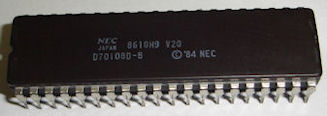
The actual chip I used.
|