Overview: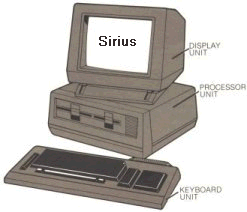
The Act Sirius 1 computer is composed of three interconnected units comprising a visual display unit, keyboard and a processor unit that contains the CPU, power supply and disk drive subsystem. A tilt and swivel turntable sits on the processor unit and allows tilt and swivel of the VDU. The keyboard plugs into the rear of the processor unit and is fully software definable. The flicker free visual display unit comes with a anti-glare screen and also plugs into the rear of the processor unit via a dedicated plug. Computer The ACT Sirius 1 computer is based on the Intel 8088 16-bit microprocessor. This processor chip is directly related to the Intel 8086 16-bit microprocessor, but with two subtle differences:
The major difference, the 8-bit data bus, has some effect on the relative abilities of the two chips; the main difference is that while the 8086 can load an entire 16-bit word of data directly, the 8088 has to load two 8-bit bytes to achieve the same result - the outcome of which being that the 8088 processor is a little slower than the 8086. The loss of speed, however, is balanced by the fact that the cost of the main circuit board and add-on boards are lower than for the wider 8086 requirement. The Sirius has a Centronics 8 Bit Parallel Printer interface and two full configurable RS-232C Serial interface sockets on the back panel. In addition there is access to twin 8 Bit parallel I/O ports via a connector on the main circuit board. There was an optional 8087 NPX co-processor (Numeric Processor Extension) commonly known as the "Maths chip" that could have been fitted. Since the Sirius was not originally designed for co-processor operation the 8087 was fitted by means of a daughter circuit board which contained the 8087 and an 8088 with their control circuitry. This daughter board replaced the original 8088 processor chip. Thus as none of the ports or the 8087 use any of the four expansion slots this leaves all four for user expansion. The only Sirius option to use an expansion slot (other than additional memory) was in the Sirius SX - Hard Disk model: here the Winchester disk drive, which has its own Micro-processor 'slave' controller acting on instruction from the main processor, passes data directly from Disk to Memory. This technique is known as DMA - Direct Memory Access - and offers very fast data transfer. To enable the disk drive to have access to the memory and the main data bus an expansion slot is used; this carries the DMA controller board. Thus one user expansion slot is occupied by the DMA controller on Sirius SX machines. There is also full sound out capabilities built in on the CPU board. Disk SystemThe ACT Sirius 1 and Victor 9000 has several integral disc configurations that were available; these are:
The Hard Disk model is known as the Sirius SX, a single floppy disk model was also available for use as a Network Workstation. Although the ACT Sirius 1 uses 5¼ inch mini-floppies of a similar type to those used in other computers (360KB PC type), the floppy discs themselves are not readable on other machines nor can the Sirius 1 read a disc from another manufacturers machine. The Sirius 1 uses a unique recording method to allow the data to be packed as densely as 620 Kbytes on a single-sided single-density mini-floppy. This recording method involves the regulation of the speed at which the floppy rotates, so that the speed of the disk media passing under the head is fairly constant irrespective of the track being used. Therefore at Track 1 ( the outer edge of the disk ) the motor turns more slowly since the circumference of track is much longer than it would be at Track 80, and as the head moves nearer the centre of the disk so the motor speed rises. This change of motor speed ( in 9 zones or steps ) explains the noise from the drive as the heads access different sections of the floppy. Display UnitThe display unit tilts and swivels via the turntable to permit optimum adjustment of the viewing angle. The unit incorporates a 12 inch (300mm) anti glare screen to prevent eye strain. The display, in normal mode, is 25 lines, each line having 80 columns. Characters are formed, in normal mode, in a 1-x-16 font cell, providing a highly- readable display. The screen may be used in high resolution mode, providing a bit-mapped screen with 800 x 400 dot matrix resolution. The high-resolution mode is available only under software control, there is no means of simply
'switching' to high-resolution mode.
Character sets are 'soft' - that is they my be substituted for alternative character sets of the users choice, or creation. Only one 256-character set may be displayed on the screen at one time. Character set manipulation software is available in both the Graphics and Programmers Tool Kits. KeyboardEvery key is programmable, permitting the offering of a National keyboard for each country in which it is found. As a result, the keyboard can be customised to satisfy the requirements of foreign languages and so that striking a key enters a character or predetermined set of commands. Keyboards are as soft as the character sets - this allows a keyboard to be generated to match a newly created or special character set. Each key on the keyboard has three potential states; the un-shifted, shifted and alternate. The un-shifted mode is accessed when the desired key is depressed, the shifted node is accessed when the shift key is depressed along with the desired key, and the alternate mode is accessed when the ALT key is depressed along with the desired key. Keyboard manipulation software is available in both the Graphics and Programmers Tool Kits. MemoryThe ACT Sirius 1 has a maximum memory capacity of 896 kilobytes of RAM (a kilobyte is 1,024 bytes). A byte is able to store one character of data - thus the Sirius 1, with full 896Kb memory capacity is able to hold, internally, nearly 1 million characters. There were two standard minimum RAM size's available - 128Kb or 256Kb. All hard disk machines were supplied with 256Kb as many modern applications (circa 1984) programs require floppy machines to have 256Kb for a program to run. The 128Kb RAM version of the machine is suitable for smaller stand alone applications. Memory MapThe ACT Sirius 1 was supplied with two major disc operating systems; CP/M-86 from Digital Research TM, and MS_DOS from Microsoft TM. Both Operating Systems were supplied with twin floppy disk machines. The Sirius SX Hard Disk model was only supplied with the MS-DOS operating system since CP/M will not support the hard disk, however a CPM emulator was supplied to allow CPM programs to be run under MS_DOS. Although these two operating systems appear superficially similar, they are quite different in their operation, program interfacing techniques, and their memory structure. The following diagrams are the memory maps for CP/M-86 and MS-DOS; you will notice that some aspects of the machine never change, such as the screen RAM and interrupt vector locations, these areas are hardware defined, and as such never alter. The memory maps for MS-DOS and CP/M-86 are not fixed in the ACT Sirius 1, thus some of the elements of the map will not be specific; this is not to be deliberately vague, but improvements to the performance aspects of the software do take place forcing the diagrams to be unspecific to some degree. 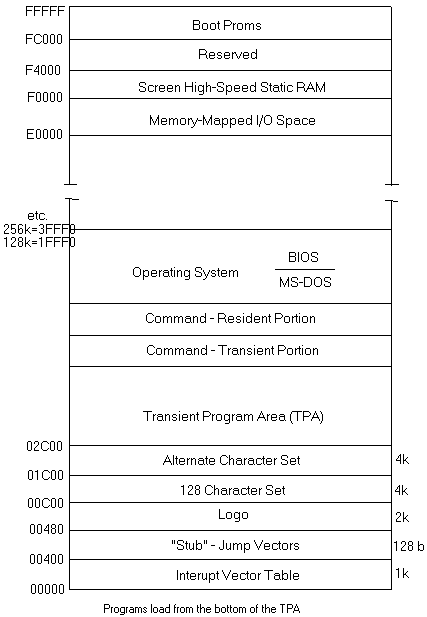
Note: that in CP/M-86 user programs load in the Transient Program Area (TPA) from the top down, whereas in MS-DOS , they load from the bottom up. CP/M-86 Memory Map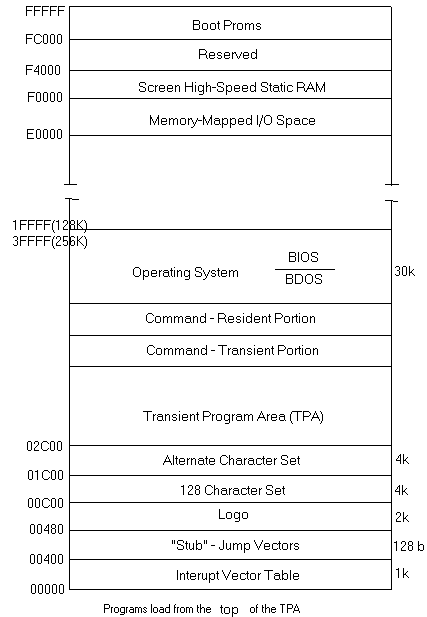
Memory Organisation The total address space of the ACT Sirius 1 is 1M byte (or 64K paragraphs; a paragraph being 16 bytes). For convenience this can be considered as 8 blocks of 128K, as follows: 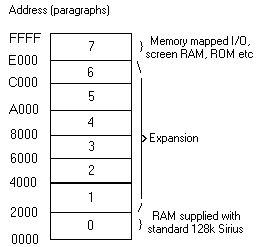
RAM expansion boards are 128K, 256K and 384K (3 x 128K) capacity. The 128K and 256K boards can be addressed at any 12BK boundary in the area of memory reserved for expansion. The 384K boards can only be addressed at memory area starting at the 256k or 512k boundaries. This prevents the use of a 384k expansion board with a 256k machine, where the CPU board is 256k.. RAM must be contiguous, thus if two 128K RAM cards are used in a standard 128K machine, for example, they must be addressed at blocks 1 and 2. The operating system always relocates itself to take account of all available memory References used for the above text include the "ACT DEALER HANDBOOK" and other sources. Last revision 30/03/2011 |